Build your first CV around your education, projects and skills. See what to include, how to arrange it and an example for a student applying for an internship.
J
Jobara
Written for the archive
1 day ago7 min read
Your first employer will want to know what you could do in the role and how you approach work. University is one place to find that evidence. So are placements, society activities, family responsibilities and projects you started on your own. Begin by gathering a few examples you can explain in an interview. Then use the job advert to decide which of them deserve space on the page.
Turn the advert into a shortlist of evidence
Read the responsibilities, required qualifications and submission instructions for one vacancy. Underline three tasks a new hire or intern would actually carry out. Make a short list of occasions when you did comparable work. If an internship involves reviewing support requests and documenting fixes, a team assignment where you reproduced a bug and recorded the steps may be relevant. A part-time job where you kept order records could help demonstrate accuracy in a different way.
Check practical requirements at the same time. Note the start date, working hours, location and any required language or tool. A final-year student can give an honest picture of availability by naming the days they can attend, the date their exams finish and any limits on commuting. Follow the employer’s instructions if the application asks for a portfolio, a specific document format or a short introductory message.
Build a first page that makes your application easy to read
Contact details and a useful profile
Use the name you want the employer to address you by, a phone number you answer and an email address you check. You can include your city and a portfolio or public project link if it helps the reader assess your work. Test any link from a browser where you are signed out. If your best work came from a placement, use a public example or describe the work in general terms when the original contains private information.
Share this article:
Related stories
Keep reading in the same lane with a few hand-picked follow-ups.
If you include a profile, use two or three lines to explain what you study, the role you want and a relevant example. A final-year informatics engineering student could say, “I’m looking for a web development internship. In a university library project, I built the booking screen in React, tested it with classmates and documented the issues the team fixed.” That gives the interviewer something specific to ask about.
Education and relevant coursework
If your degree is the main qualification for this role, place education near the top. List your university or institute, field of study, and graduation year or expected graduation date. On Jobara, select your university and field from the lists. If the qualification is in progress, select “Still studying” and add your expected graduation date. One relevant module or project can help a reader see why the course matters to the advertised work.
If a placement or part-time role gives you stronger evidence, put it above education. You can still keep the qualification visible by using a short heading and a consistent date format. A recruiter should be able to see at a glance which qualification you hold or are working towards, the organisation you worked with, and when each experience took place.
Write project and experience entries that show your part
Give each entry a clear name and date. Use a verb that describes your contribution, then say what you worked on, how you did it and what you produced or improved. If you have an accurate number, use it to explain the scale. You can also name the deliverable, such as a tested screen, a monthly summary or a set of training materials. In team projects, describe the part you owned so you can explain it clearly in an interview.
University project, library booking system. Built a React screen for finding reservations, kept track of feedback from six classmates and documented a duplicate booking issue for the team.
Volunteer workshop. Prepared a short Python exercise for new students, walked a small group through it and revised the instructions after the first session.
Part-time shop assistant. Checked incoming stock against delivery records and updated a spreadsheet so the manager could follow up on missing items.
Label each example according to what it was. An independent project or volunteering experience can have its own heading. If paid work is unrelated to your target field, keep a short entry for the tasks that demonstrate useful habits, such as maintaining records, working to a deadline or responding to customers. A placement can also show how you worked with supervisors, even if you mainly observed and assisted.
Give skills, courses and languages enough context
Treat the skills section as a quick summary of things you can demonstrate. “Excel: formulas, filters and simple charts for survey data” gives a clearer picture than a software name on its own. If a requirement mentions English, say whether you use it to read instructions, write messages or give presentations. Use an exam result or certificate if you have one and it matters to the advert.
For a short course, give the provider and date with the task you completed. You might mention a spreadsheet dashboard you created or a one-page research brief you wrote. Think about what you could explain without notes if an interviewer asked you about the course. That will help you decide which training to list and how much detail to give.
Worked example for a web development internship
This fictional example is short enough to fit on a first CV. The role asks for basic React, teamwork and an example of a project. Follow the way the example links those requirements to evidence when you write your own version.
Nour Ibrahim | Aleppo
Add your working contact details and one public project link.
Profile and education
Final-year Informatics Engineering student seeking a web development internship. Built and tested the booking screen for a university library application as part of a small project team. BSc in Informatics Engineering, University of Aleppo, expected 2027.
Project and volunteering
Library booking application, spring 2026. Built the React booking screen and connected it to the team’s Node.js API. Reproduced a duplicate booking issue and wrote steps the team used to verify the fix.
Introductory programming workshop, autumn 2025. Prepared an exercise and helped students work through common errors. Updated the workshop notes with questions they raised.
Relevant skills and availability
React components and basic API calls, Git branches and pull requests, technical documentation in English. Available for three weekdays a week after final exams, with exact days to be agreed.
Make a second version for a different vacancy
Imagine the same student applying for a technical support role after graduation. The first version puts building the interface near the top. The second can lead with reproducing the booking issue, recording what happened and checking the fix. For an operations job, a graduate might lead with tracking requests, organising handover notes or checking the quality of records. Start again from the tasks in the new advert and move the strongest example into view.
Keep a master list of placements, responsibilities and projects with their dates. Copy only the relevant items when you prepare a new CV, and keep the finished version with the advert so you can refer to it before an interview. Jobara’s general CV writing guide explains how to develop the rest of the document as you gain experience.
Finish with a practical check
Check names, spelling, dates, phone number and email. Read the file as if you were seeing it for the first time.
Follow the advert’s instructions for language and file type. If the employer accepts PDF, export from a text document and check that you can select the text.
Open the final file on a phone and computer. Verify that headings are distinct and that Arabic text, numerals and English tool names read in the right order where you mix languages.
Aim for a single readable page at this stage. A second page can make sense when you have additional relevant work. Use a file name that clearly identifies your CV.
Pick a live internship or entry-level role and draft one line of evidence for each of its main requirements. If one task is still unfamiliar, use it to choose what to practise next. After you finish, ask a classmate to tell you which part of your CV best matches the role.
A practical guide to looking for work in Syria, covering where to find suitable opportunities, how to apply and follow up, with sample messages and advice on checking job adverts.
2 months ago8 min read
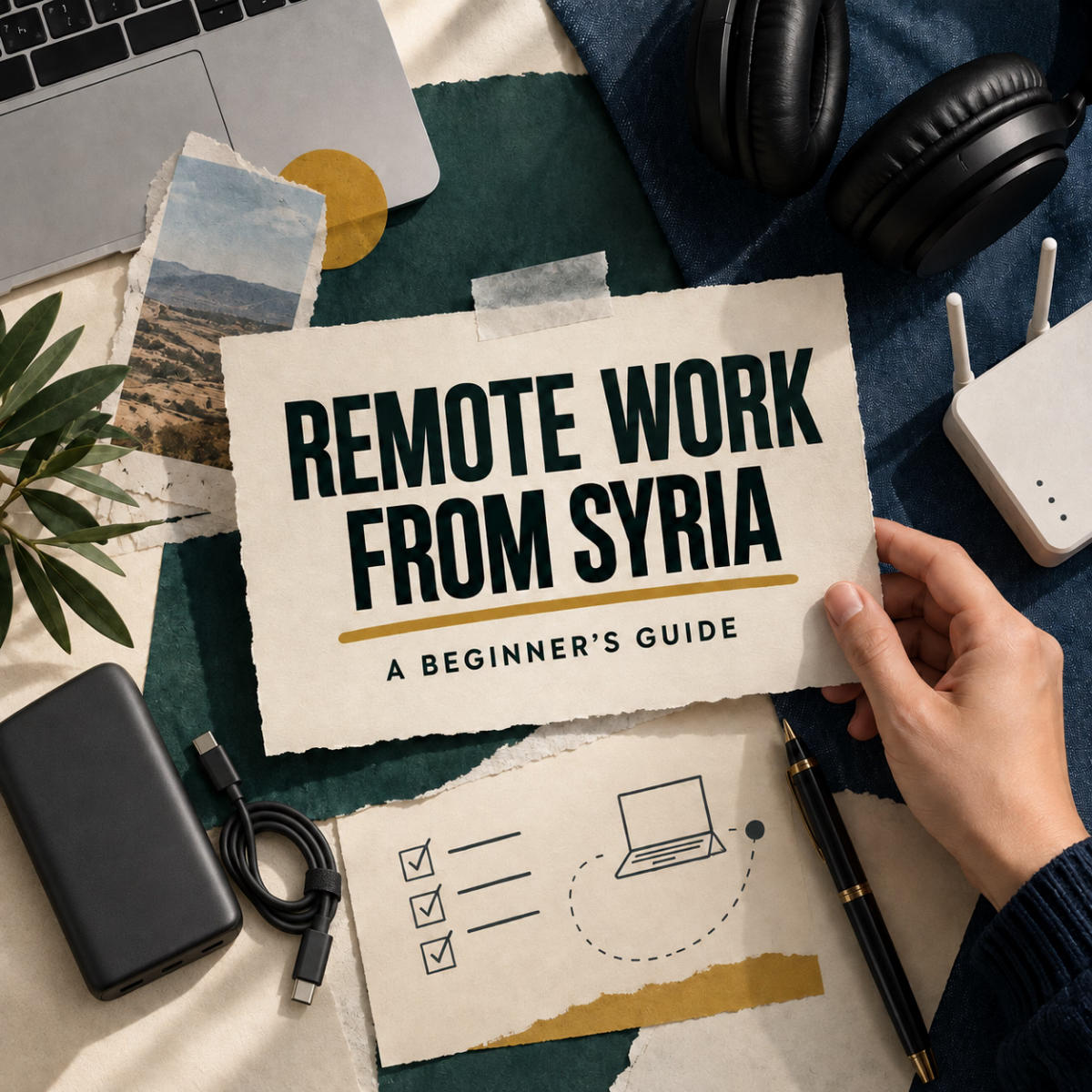
Remote Work from Syria: A Beginner’s Guide
This guide explains how to start remote work from Syria, choose a suitable field, identify the skills you need, build work samples, assess opportunities, and apply safely.